



My Guide to Working in the Food Industry as a Nutritionist
There is an ever-increasing demand for nutritionists in the food industry. Partly because companies need/want to adopt a greater presence in the health and wellness space and partly due to them needing expertise to help them through the complexities of government/stakeholder expectations and legislative requirements.
Ultimately public health would really suffer without companies employing or contracting nutritionists to work with them and these roles can be really powerful positions. Through making the food supply healthier we can collectively work towards achieving population nutrition targets and the reduction of nutrition-related diseases.
I have worked with hundreds of food companies (mainly via my consultancy – I’m not a serial job hopper!) and I find it an incredibly rewarding sector. In particular, I enjoy working on new product/reformulation launches and developing nutrition strategies. My work is so varied though, and that’s one of the reasons I love it!
I should also say that it’s not always easy! You won’t always agree with the direction companies choose to take; you might be faced with tough stakeholders or journalists; you might get frustrated with how long it takes to implement initiatives…but as your career progresses, you’ll learn how to handle these constraints.
What types of companies have Nutritionists within their teams?
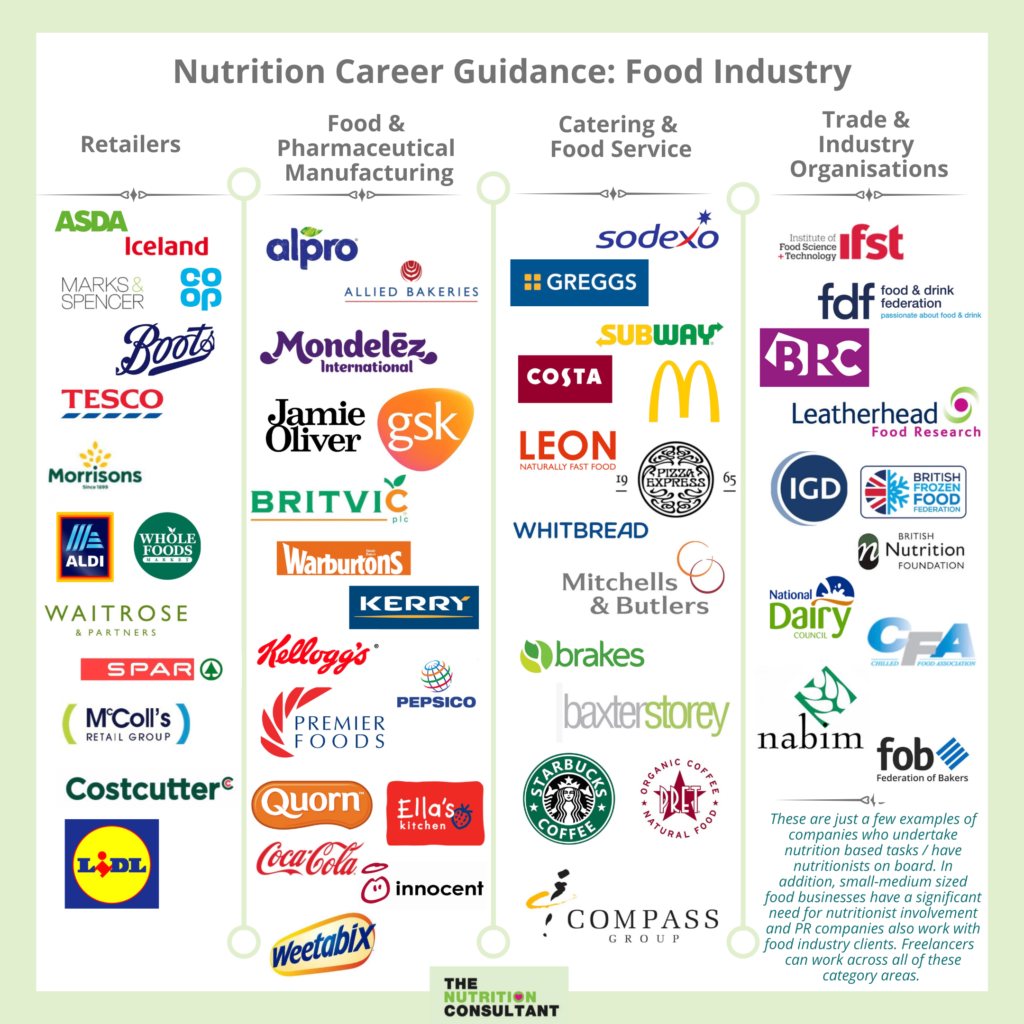
What areas do industry nutritionists get involved with?
The role of an industry nutritionist is very varied and the list below is not an exhaustive list. Specific job roles will depend on the company’s job description.
Product Development:
- Recipe analysis
- Highlighting new and emerging trends/consumer insights
- Advising on the nutritional composition of new and existing products
- Assisting with the design of products with specific dietary needs
- Supporting the development of new products
- Reformulating foods to make them healthier (e.g. lower salt, higher fibre)
Regulatory Affairs:
- Interpreting legislation & ensuring company compliance
- Nutrition and health claims
- Packaging labelling
- Calorie labelling on menu boards
- Advertising (e.g. nutrient profiling products, advising/signing off nutrition elements of TV scripts)
- Contributing to the development of new legislation/industry best practice
- Responding to government consultations
Communications:
- Media relations – journalist enquiries/interviews/writing or contributing to press releases
- Manning exhibition stands
- Giving external presentations
- Writing customer leaflets/social media posts
- Dealing with customer enquiries
- Representing the brand at external meetings
Employee Wellbeing:
- Nutrition training
- Promoting healthy eating within the organisation
- On-site restaurants (e.g. advising on menu choice/calorie labelling)
Research and Scientific Work:
- Planning research programmes/preparation of scientific papers
- Liaising with external academics
- Building scientific evidence to support nutrition claims for new products
Other:
- Supporting marketing campaigns, substantiating product claims development and clearance of broadcast and press advertising
- Quality assurance
- Food safety
- Involvement in industry committees (e.g. British Retail Consortium, British Hospitality Association, Institute of Grocery Distribution)
- Nutrition strategy and policy development/implementation
- Allergens

Where are industry jobs advertised?
Food manufacturer or food company websites.
Recruitment agencies such as Nutrition Talent, b3 Jobs, Total Jobs, Reed, Indeed, Your Food Job, Food Careers, KPI, Nigel Wright Group, Caterer, and Simply Hired.
Some organisations will also advertise food industry roles such as the Association for Nutrition, The Nutrition Society, IFST and local councils (for schools etc).
Networking also opens the door to opportunities through personal contacts, word of mouth and even speaking to career advisors.
Newspapers and magazines may advertise jobs, such as Guardian Jobs, New Scientist, The Grocer and Food Manufacture.
And don’t forget social media! Keep up to date with the latest jobs on LinkedIn, Twitter (@zg_nutrition is great for new job updates) and Nutrition Graduates (website and Facebook page).
It’s important to remember that not all nutrition roles have ‘nutrition’ or ‘nutritionist’ in their title! These are just some examples of other nutrition-related roles within the food industry:
- New Product Development
- Regulatory Affairs
- Public Affairs/Comms/Marketing
- Food Scientist
- R&D/Specification/Quality Food Technologist
What skills could be an advantage?
These are some of the areas which can complement an industry nutrition role. You don’t have to be competent in all of these – most will develop as your career progresses.
Industry-specific skills, such as:
- Knowledge of ingredient functionality
- Food safety/Microbiology/HACCP
- Product development
- Nutritional analysis
Communication skills, such as:
- Writing
- Listening skills
- Presentation skills
- Negotiation skills
Analytical and problem-solving skills, such as:
- Maths and numeracy
- Ability to handle, interpret and summarise scientific data
- Observational skills
- Strategic thinking
- Consumer insights
Marketing skills, such as:
- Knowledge of brand marketing
Management skills, such as:
- Planning/Project management
- Business management
Personal skills, such as:
- Adaptability to change
- Team working
- Resilience
- Time management
- Ability to work solo
- Enthusiasm
- Thinking on your feet
- Willingness to learn
Are there any rules about what nutritionists can/can’t work on?
Most employed work within the food industry is conducted ‘behind the scenes’. This means you are there to guide companies and provide internal expertise.
From a nutritional perspective, there are no specific rules about what you can/can’t do unless you are asked to be part of consumer-facing campaigns, in which case you need to be extremely cautious about what your name/face/registration is added to. For example, health care professionals are not allowed to market any product bearing health claims in a commercial context or use terminology such as ‘nutritionist approved’.

Bonus Top Tips
- Learn how to use nutritional software – consider attending a recipe analysis course such as the one run by Susan Church.
- There may be times when you do not agree with actions that companies take (this is often out of your control) but ensure you keep your personal and professional ethics in high regard.
- Make sure you have a clear job description before accepting a job role so there will be no surprises when you start.
- Think about all the subject areas which might be relevant to the food industry aside from nutrition (e.g. biochemistry, microbiology, business management, marketing, consumer insights, farming, food safety, and food chemistry). If you didn’t do these are a part of your degree, consider doing a short course to gain familiarity to the subjects. It’s not enough to have a desire to change menus, you will need an understanding of the technical elements (e.g. if you reduce sugar from ice cream what might that do to the ice crystal formation/matrix?)
- Read through different legislation/guidance documents so you have an understanding of what is expected of food businesses e.g. Nutrition and Health claims, Food Information Regulation, General Food Law, ASA Rulings, Nutrient Profiling (HFSS classification tool) UK Front of Pack Guidance.